---
title: An Excerpt from Muted Cry by Caroline J. Simon
description: Explore the complexities of grief and affliction through the lens of personal loss and philosophical insights, revealing deeper truths about suffering and humanity.
image: https://blog.fortresspress.com/hubfs/Fortress%20Press/FP%20S26/Blog%20Images/Banner_1.jpg
---
[](https://www.fortresspress.com)
- [Blog Home](https://blog.fortresspress.com)
- [Excerpts](https://blog.fortresspress.com/tag/excerpt)
- [Interviews](https://blog.fortresspress.com/tag/interviews)
- [Op-Eds](https://blog.fortresspress.com/tag/op-ed)
- [Resources](https://blog.fortresspress.com/tag/resources)
- [Shop Now](https://www.fortresspress.com/)
## [An Excerpt from Muted Cry by Caroline J. Simon](https://blog.fortresspress.com/an-excerpt-from-muted-cry-by-caroline-j-simon)
Jan 27, 2026, 12:15:00 PM / by [Caroline J. Simon](https://blog.fortresspress.com/author/caroline-j-simon)
I got off the return flight six days after my brother Bill’s death in September 2020 angrier than I could remember ever having been. The direct focus of my anger was the jerk who’d sat next to me on the plane. Half the time his mask dangled around his neck; the rest of the time it hung well below his nose. But my anger was out of proportion, even in those pre-vaccine days when masking or not masking was a source of rage.
I’ve read that anger is one of the stages of grief, so it was natural for me to ask myself whether that was what I was feeling, perhaps heightened because the COVID pandemic had sapped my resiliency. Yet as I palpated my anger, I detected lumps of moral indignation. Some part of me was reacting to a deep wrong. My anger felt like the oddity at a crime scene—the one that becomes not just a clue, but the key to unlocking some mystery.
Good mysteries require multiple suspects. Let me give you an initial sketch of the lineup in this case, to be filled in as the story unfolds.
My brother Bill Miller had spent six years as one of over two hundred thousand people in the United States receiving ongoing dialysis, a multibillion-dollar industry. He had also spent multiple years on the kidney donation candidate list, and stretches of time on Medicaid, on what used to be called welfare (now called SSI—Supplemental Security Insurance), on disability, and on Medicare. Was the wrong that I was reacting to embedded in the injustices endemic to these large-scale systems? Perhaps.
Bill was admittedly not the most responsible, self-disciplined, prudent person. Was my moral indignation triggered by what Bill’s faults had cost him and the collateral costs they’d inflicted on me? It’s possible.
Another hypothesis is that my anger was self-directed. One of Jesus’s most well-known stories is usually called the Parable of the Prodigal Son, though it’s about two sons. Their father wanted desperately for them both to come home and stay home, to be reconciled with each other. In Jesus’s telling, as soon as one son returns, the other leaves. Were my brother and I enacting a version of this story—my brother, the prodigal, and I, his self-righteous sibling? Much as I dislike thinking I’m a stingy, judgmental prig, part of me periodically suspects that’s true. At such times, my self-directed ire is aggravated by knowing I am not in the best position to judge. What we think we know about ourselves and others is often composed of self-serving yarns.
I have come to believe that whatever else this story is about, it can help us ponder the mystery of affliction—a morally important and much-neglected concept. Affliction involves not just physical and emotional suffering, but social and spiritual dislocation. Simone Weil calls it “the great enigma of human life,” and distinguishes it from pain, suffering, and sorrow. Pain, suffering, and sorrow often incapacitate us but leave us intact after they pass. Affliction leaves a person undone. “Soul destroying” is, for most users, a metaphorical expression. When Weil talks about affliction destroying souls, she invites us to take her seriously.
A new book or article on trauma appears almost weekly: childhood trauma, intergenerational trauma, everyday trauma. Books about affliction are rare, though Weil thought that affliction hides in plain sight all around us. One reason for the hiddenness of affliction is that it renders the afflicted inarticulate. But the more important reason that affliction remains stubbornly enigmatic is our desperate, mostly unconscious, desire not to see. The roots of our desperation lie in our complicity in allowing customs and practices that plunge others into affliction. Our complicity comes in many forms: cowardice, inertia, and culpable ignorance. “It is certain that each of us is involved at least in the guilt of criminal indifference,” says Weil.
Conjecturing affliction as a prime suspect in Bill Miller’s story need not lead us to eliminate other culprits. Affliction has many minions. This contributes to its ability to hide. Structural injustice, criminal indifference, lovelessness, and even the afflicted themselves number among those minions, at least potentially, according to Weil.
A roster of suspects is not an indictment. As you read, make up your own mind about Simone Weil’s ideas, and about my brother, and about me. In the end, even if you doubt that affliction was my brother’s assailant, or even his stalker, what you learn about affliction as this tale unfolds will expand your capacity to attend to the afflicted.
Paying real attention to the afflicted is costly. Weil says it always entails self-loss. Why, then, would you want to enhance your awareness of this condition? For Weil, affliction is a key theological term. Understanding affliction opens our eyes to deep truths about Christ, about humanity, and about how to follow Christ in God’s precious, broken creation. To the extent that we remain blind or indifferent to affliction, we flatten and falsify the world.
Yet, an interest in theology is not a prerequisite for finding Weil’s subtle and psychologically rich descriptions of affliction insightful. Because Weil thought her peculiar calling was to witness from “the intersection of Christianity and everything that is not Christianity,” much of what she has to say on most topics is worthy of consideration by thoughtful people of many faiths or none. You may in the end disagree with her, but she will not waste your time.
All human lives are particular—even peculiar—but they are also intertwined, however distantly. I’m neither an ancient Roman North African nor a first-generation Chinese American, yet Augustine’s story in his *Confessions* about his boyhood raid on a neighbor’s orchard and the story that Maxine Hong Kingston tells of her no-name aunt in *The Warrior Woman* both give me what Kingston calls ancestral help. Perhaps you yourself have been afflicted or tried to help someone who is. Perhaps you, like many contemporary Americans, think that affliction happens seldom and always far away. Whatever your circumstances, I hope that this story of two siblings will spur you to ask how affliction’s enigmas pertain to your own life. Those are questions you alone, or in some cases God alone, can answer.
[](https://www.fortresspress.com/store/product/9798341900271/Muted-Cry)
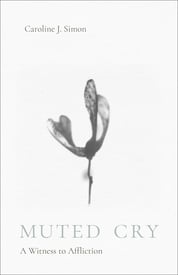
Affliction uproots lives, damaging people physically, psychologically, socially, and spiritually. Such multifaceted suffering overwhelms its victims and baffles those attempting to help. Caroline Simon puts her sometimes clumsy efforts to help her afflicted brother in conversation with philosopher Simone Weil's insights concerning affliction.
[Shop Now](https://www.fortresspress.com/store/product/9798341900271/Muted-Cry)
- [Tweet](https://twitter.com/share)
Topics: [Grief](https://blog.fortresspress.com/topic/grief), [Excerpt](https://blog.fortresspress.com/topic/excerpt), [Philosophy](https://blog.fortresspress.com/topic/philosophy), [Simone Weil](https://blog.fortresspress.com/topic/simone-weil)

#### Written by [Caroline J. Simon](https://blog.fortresspress.com/author/caroline-j-simon)
Caroline J. Simon has published five books and scores of book chapters and articles. Her books Bringing Sex into Focus: The Quest for Sexual Integrity and The Disciplined Heart: Love, Destiny, and Imagination grapple with aspects of human affection. Her other work explores topics at the intersection of philosophy, literature, and theology, as well as a wide range of ethical and higher-education issues.
[](https://www.fortresspress.com)
©2026 Fortress Press. All Rights Reserved.